
EDITH SITWELL Five Variations on a Theme 1933 1st SIGNED ASSOCIATION PRES
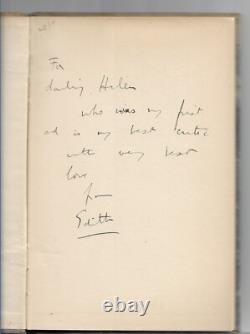






Five Variations on a Theme. This is a significant ASSOCIATION COPY with the.
To Helen Rootham on the front fly leaf. For darling Helen who was my first and is my best critic with very best love from Edith'. [The word'was' has been amended from'is'].
It was published by Duckworth, London in 1933. The foot of the spine is slightly bumped, and the head of the spine is bumped and has some loss. Some browning towards the head of each board but a good, tight copy. Complete with its unclipped dustwrapper which has a dulled spine panel with some slight loss at the head, but is otherwise very good.
1000 copies of this book were printed. Xcepting, perhaps, her brother Osbert, Dame Edith Sitwell's closest emotional bond was with Helen Rootham. In 1903 Rootham, an aspiring poet, was engaged as her governess.The relationship between the two women proved crucial for the rest of Rootham's life and a good part of Sitwell's. Under Rootham's tutelage, Sitwell was introduced to the French symbolist poets whose influence is evident in her work. Sitwell gave Rootham much of the credit for the fact that she became a poet. In 1913 the two women left Renishaw Hall, the Sitwell family home, and set up lodgings in a small flat in London.
In 1928 Helen Rootham developed cancer and in 1932 they both moved to Paris where they lived with Rootham's sister. In 1932 her translations into English of the prose poems from Arthur Rimbaud's Les Illuminations was published by Faber & Faber, with an Introduction by Sitwell.
One of Greene's strongest themes is Edith's tenderness towards her ageing former governess Helen Rootham, and Helen's sister Evelyn. They were even poorer than she, and often ill. They were millstones round her neck, and although she complained about them she never let them down, sharing her pittance with them. She never forgot that Helen Rootham had been her saviour and mentor when she was a girl.
Rootham had provided whatever education Edith had, and her influence, as Greene persuasively argues, was permanent. From Victoria Glendinning's review of Richard Greene's. Edith Sitwell: Avant Garde Poet, English Genius. Though unmarked as such, I understand that this book was subsequently in the library of Samuel Courtauld.